

Empowerment through Knowledge
NRL is dedicated to improving global infectious disease testing through knowledge sharing and education. Our consulting, training, and mentoring programs emphasise self-sufficiency, sustainability, and cultural sensitivity. We tailor our services to meet the unique needs of each partner, enhancing laboratory and community-based testing. Through initial capacity assessments, we create customised training and mentoring plans that foster long-term, trust-based professional relationships.
View Our Prospectus For More
Overview - What do we do?
-
The scope of NRL’s consulting, training and mentoring activities ranges from:
- Providing one-off technical training or advice to troubleshoot and address specific knowledge gaps, or design and/or verify a new process or program.
- Performing capacity assessments and gap analyses to identify and inform capacity building strategies and workplans.
- Design and delivery of customised training programs including mentoring sessions aimed at addressing specific needs, priorities or challenges, at an organisational or national level. For example, supporting the development of National External Quality Assessment Schemes or supporting an organisation to undertake the journey towards full quality accreditation.
- Delivery of train-the-trainer programs to empower selected local trainers to educate and mentor others.
- Development of guidance documents in collaboration with partners such as the World Health Organization.
NRL provides consultancy, training and, mentoring services in the following areas:- Quality Management Systems, including capacity development towards attaining compliance and/or accreditation to national and international standards (e.g. ISO 15189, ISO 17043 and Codes of GMP).
- External Quality Assessment Schemes (EQAS), including the design and implementation of a sustainable national EQAS to quality assure testing of local laboratories; and reduce the reliance on international, expensive and inconsistent support.
- Test Kit evaluation and supporting reference laboratories to design protocols, maintain appropriate samples and assess key performance characteristics of a test kit at a given point in time; including the use of data to recommend test kits for use in-country, often as part of a regulatory framework.
- Testing Algorithms including support to reference laboratories for the development of a national testing strategy that is appropriate for in-country context, and the design and validation of a testing algorithm through the testing of carefully characterised samples in different assay combinations.
- Laboratory Quality Control
- Point-of-Care Quality Assurance
- Equipment Procurement, Validation and Maintenance
- Biosafety and Biosecurity
- Capacity Assessments
Where do we work?We have significant experience working with Ministries of Health, international development partners, and laboratory and community-based testing personnel in a range of countries.
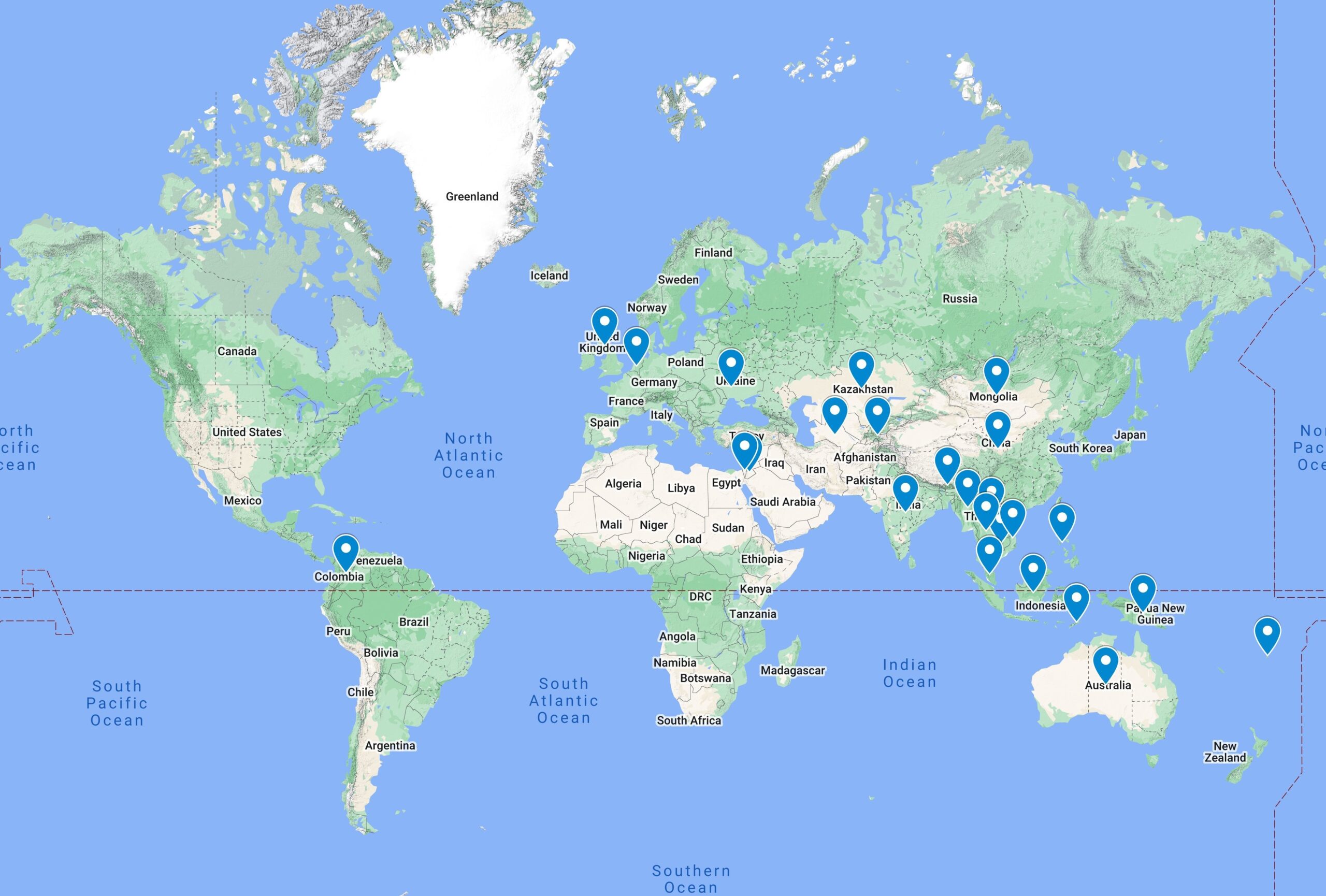
(Cambodia, Laos, Indonesia, Philippines, Myanmar, Vietnam, Mongolia, India, Bhutan, Tajikistan, Turkmenistan,
Kazakhstan, Jordan, Timor-Leste, Thailand, Fiji, China, PNG,Columbia, Israel, Malaysia, Netherlands, Ukraine, United Kingdom, Australia)
Current Projects
-
Training Mission in the Maldives
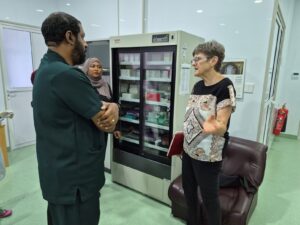
In November 2025, the NRL Scientific Consulting and Training Team conducted an in-country gap assessment of Ministry of Health laboratories in the Maldives to evaluate the status of existing quality management systems and identify areas requiring improvement. The assessment was conducted against the requirements of ISO 15189:2022 — Medical laboratories: Requirements for quality and competence.
Dr Innocent Mupunga and Ms Vee Armstrong led the assessment, and visited hospital laboratories in Malé, Hulhumalé, and Gan Island (Laamu Atoll). The work was coordinated and led by Uza. Thasleema Usman (Commissioner of Quality Assurance at the Ministry of Health) and her team in collaboration with the Maldives WHO country office. The laboratories assessed included the (National Health Laboratory NHL) of Maldives Food and Drug Authority, the Maldives Blood Services, three tertiary hospital laboratories, one regional hospital laboratory, and one primary health care centre laboratory.
The team also met with the Minister of Health and other senior Ministry of Health officials, during which key national achievements and ongoing priorities were discussed. A major highlight shared was the Maldives being the only country to have attained triple elimination of mother-to-child transmission of HIV, hepatitis B, and syphilis. However, during the validation process for triple elimination, a significant gap identified was the lack of comprehensive quality assurance across laboratory testing systems. The NRL gap assessment further confirmed these quality assurance gaps.
Following the assessment, NRL developed a targeted workplan to provide training and technical support to the Maldives MoH to address the identified gaps. Implementation of this support is expected to commence before the end of Q1 2026.
NRL acknowledges the support of WHO Southeast Asia and Maldives Country Offices, and the Maldives Ministry of Health in delivering this project.
Past Projects
-
Indonesia – Laboratory Quality Management Systems (QMS) Capacity Building
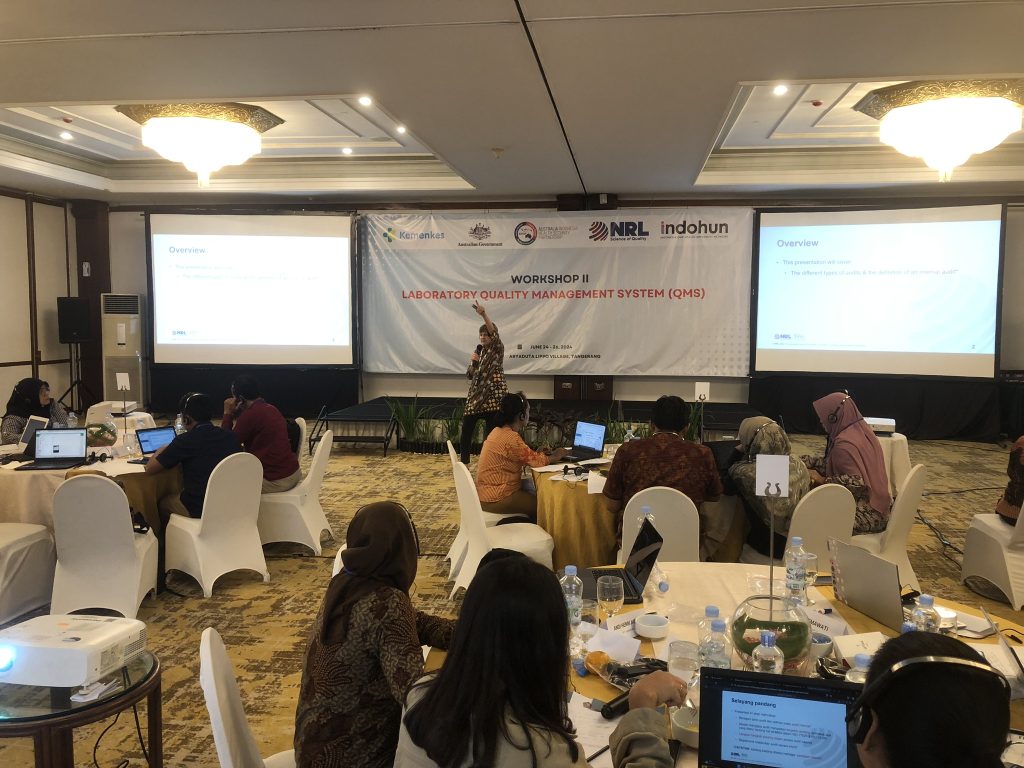
In 2023, NRL’s Scientific Consulting and Training (SCT) team implemented a laboratory capacity-building and strengthening program in Indonesia in collaboration with the Australia Indonesia Health Security Partnership (AIHSP) and the Indonesia One Health University Network (INDOHUN). The program focused on strengthening Quality Management System (QMS) implementation across primary, district, and provincial health laboratories in five provinces, with the aim of improving testing quality for clinical diagnosis and public health surveillance.
The SCT team delivered two face-to-face training workshops. The first, held in Yogyakarta in January, provided foundational QMS training with a focus on risk identification, risk management, and core QMS principles. Site visits were conducted to better understand laboratory workflows, resources, and operational challenges. The second workshop, held in Tangerang in June, delivered advanced training based on participant feedback and earlier assessments, including risk assessment and registers, nonconformity management, internal audits, biosafety and biosecurity, and alignment with ISO 15189.
Both workshops were attended by designated Quality Champions from participating laboratories, observers from reference laboratories, the Ministry of Health, and national health training centres, as well as representatives from AIHSP and INDOHUN. Stakeholder meetings were also held to support alignment and sustainability of the program outcomes.
Yayasan KNCV Indonesia (YKI)In 2023, NRL collaborated with Yayasan KNCV Indonesia (YKI) and the Indonesian Ministry of Health to assess and strengthen the capacity of four laboratories to develop and deliver a national HIV Viral Load External Quality Assessment Scheme (EQAS). Supported by the Global Fund, the project included virtual theory training, an on-site practical workshop in Makassar, and individual laboratory capacity assessments. The collaboration strengthened staff capability and identified priority actions required for each laboratory to meet national EQAS provider requirements.
Sri LankaIn mid-2023, NRL conducted an assessment of the Sri Lanka National Blood Transfusion Service (SLNBTS) on behalf of WHO SEARO. The assessment evaluated SLNBTS’s capacity to become an External Quality Assessment Scheme (EQAS) provider for laboratories across the South-East Asia region. Findings were used to inform the development of a customised training program for future delivery. NRL provided a final report outlining key gaps, priorities, and a detailed action plan.
IndiaDuring 2023, NRL delivered EQAS training and capacity-building support to the Indian Institute of Medical Research on behalf of WHO SEARO. The project supported 15 institutes to progress towards becoming EQAS providers for current and emerging infectious diseases. Activities included virtual theory training, followed by an on-site practical workshop at the National Institute of Virology in Pune. Post-training mentoring supported the institutes as they commenced implementation of their pilot EQAS programs.
WHO Western Pacific RegionIn collaboration with the WHO Western Pacific Regional Office, NRL completed an evaluation of access to laboratory services at the primary healthcare level across the Western Pacific Region. The project supported commitments under the Regional Framework for Reaching the Unreached (2022–2030). Best practices and challenges were identified through regional consultation, with findings prepared for publication by WHO.
Australia Indonesia Health Security Partnership (AIHSP)In 2023, NRL collaborated with the Australia Indonesia Health Security Partnership (AIHSP) and the Indonesia One Health University Network (INDOHUN) to strengthen laboratory quality systems in Indonesia. The project supported primary, district, and provincial public health laboratories across 10 districts in five provinces. Tailored training and mentoring programs were delivered, with designated Quality Champions leading local quality improvements. Funded by DFAT, the initiative strengthened laboratory capacity across public health and hospital systems.
Articles
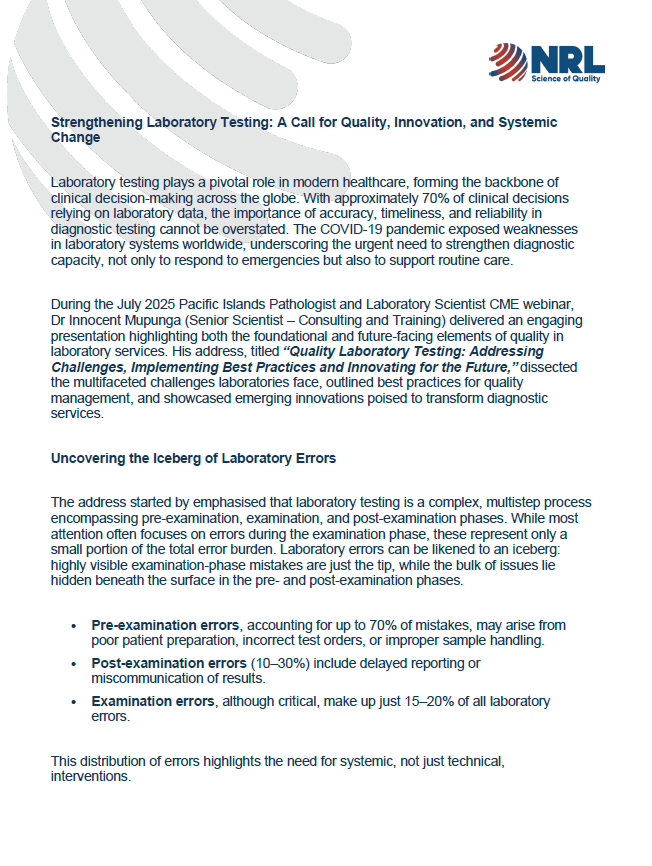
Strengthening Laboratory Testing – A Call for Quality, Innovation, and Systemic Change
Download NowNRL have partnered with numerous government, NGO and funding bodies to deliver capacity building programs.